 150
How to Tell if Argan Oil Is Real: 7 Signs to Check Before Buying
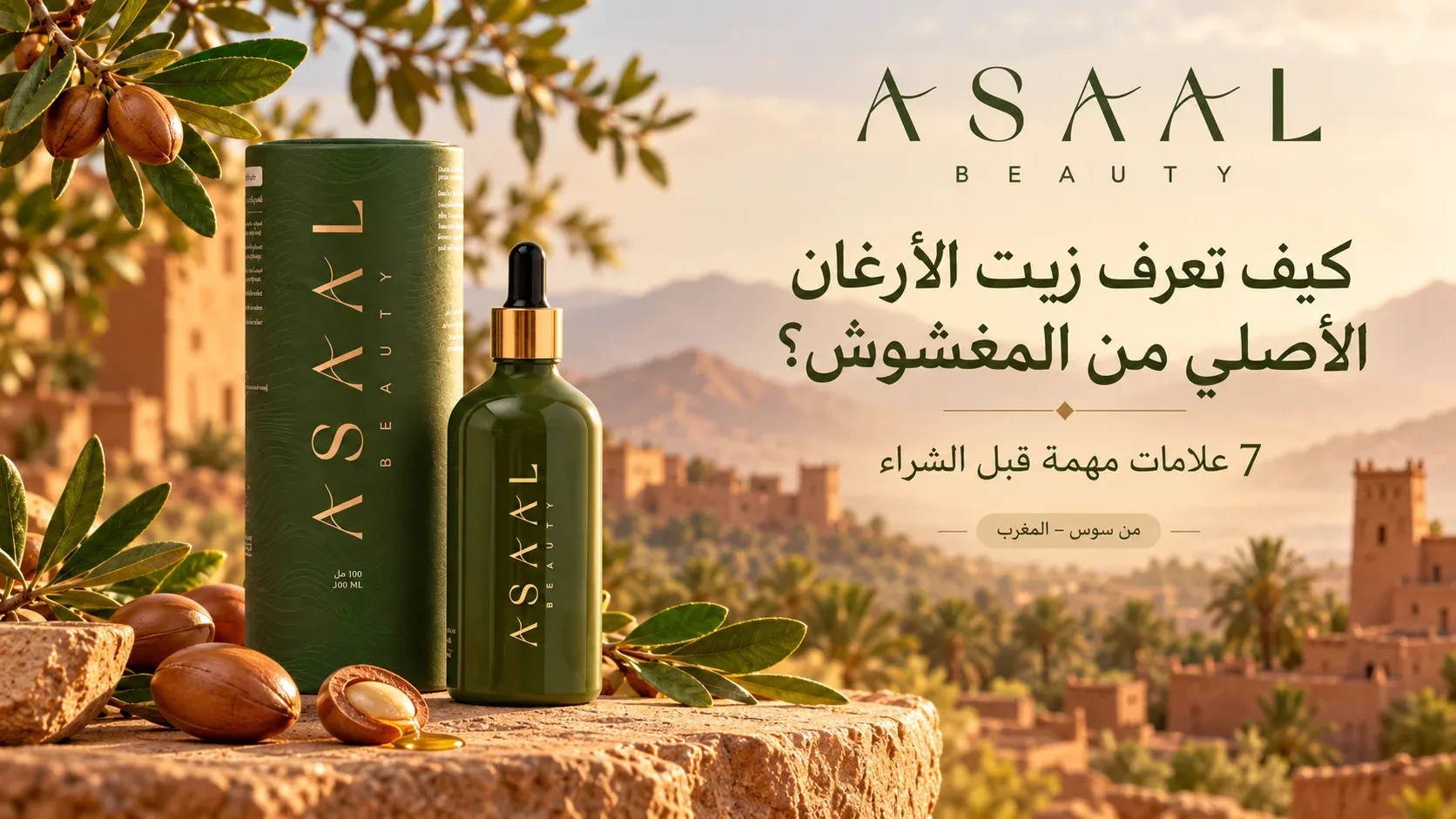
Discover 7 ways to identify authentic Moroccan argan oil, from its ingredients and Souss origin to cold pressing, organic certifications, traceability, and lab testing.
How to Tell if Argan Oil Is Real: 7 Signs to Check Before Buying
Is every bottle labeled “Moroccan argan oil” genuinely pure? Can you recognize authentic argan oil from its color or scent? And what is the difference between pure, organic, and cold-pressed argan oil?
With so many argan oil products available for hair and skincare, choosing the right one requires looking beyond price, packaging, and marketing claims.
To identify authentic Moroccan argan oil, start with the ingredients, country of origin, extraction method, certification information, and quality documentation. Color, scent, and texture can offer clues, but none of them can conclusively establish purity on its own.
In this guide from Asaal Beauty, we explain seven important checks before buying argan oil, explore the heritage of Morocco's Souss region, and show how to distinguish genuine oil from misleading products.
How to identify real argan oil: The quick answer
Before buying a product labeled 100% pure argan oil, check the following:
- Ingredients: Look for Argania Spinosa Kernel Oil as the only ingredient.
- Origin: Look for clear Moroccan origin information.
- Extraction: Check whether the oil is cold-pressed and intended for cosmetic use.
- Certification: Review relevant organic credentials, such as USDA Organic and certification through ECOCERT.
- Packaging: Look for a batch number, shelf-life details, and storage instructions.
- Appearance: Evaluate color, scent, and texture without treating them as definitive proof.
- Testing: Prefer brands that provide meaningful quality information and relevant laboratory testing.
Together, these checks support a more informed purchase. However, confirming purity through chemical analysis requires specialized laboratory methods.
What is authentic Moroccan argan oil?
Argan oil is obtained from the kernels of the argan tree, scientifically known as Argania spinosa.
It naturally contains fatty acids and vitamin E compounds and is used in products for hair, skin, and body care.
However, not every product described as argan oil has the same composition.
Some contain only argan oil. Others are cosmetic formulations combining argan oil with additional plant oils, fragrance, or other ingredients.
A blend is not automatically counterfeit. A correctly labeled formulation can legitimately contain argan oil alongside other ingredients.
The issue arises when a blend is presented as 100% pure argan oil or when its ingredients or origin are misrepresented.
Seven signs of genuine Moroccan argan oil
1. Start with the ingredient list
The ingredient list is one of the most useful checks available to consumers.
For a single-ingredient cosmetic argan oil, look for:
Argania Spinosa Kernel Oil
If the formulation contains other oils, silicones, or fragrance, it is not a single-ingredient argan oil.
That does not necessarily make it a poor product. It simply means it serves a different purpose from a bottle of pure argan oil.
Remember: A product marketed as “infused with argan oil” is not necessarily the same as 100% pure argan oil.
2. Check its Moroccan origin
Morocco is the historic heartland of argan oil production, with argan trees particularly associated with the country's southwest.
For buyers seeking authentic Moroccan argan oil, clear origin information is an important part of understanding the product.
However, a Moroccan origin statement alone does not prove that the contents are undiluted.
Authenticity also depends on the actual composition of the oil and whether the product's description is accurate.
This is where the Souss region of Morocco becomes especially relevant.
Why is Morocco's Souss region so important for argan oil?
The Souss region, in southwestern Morocco, is one of the most significant natural and historical areas associated with argan trees and argan oil production.
It is valued for its connection to the native argan ecosystem and the traditional knowledge developed around harvesting and oil extraction.
UNESCO designated the Arganeraie Biosphere Reserve in 1998. In 2014, traditional practices and knowledge concerning the argan tree were also inscribed on the Representative List of the Intangible Cultural Heritage of Humanity.
The biosphere reserve extends across parts of the Souss-Massa and Marrakech-Safi regions.
What makes Souss distinctive?
Natural heritage: Argan trees are closely associated with the dry and semi-arid ecosystems of southwestern Morocco.
Traditional expertise: Local knowledge concerning argan harvesting, kernel preparation, and oil extraction has been preserved across generations.
Geographical identity: Souss is closely connected with the natural source of argan oil, rather than being merely a commercial packaging location.
Recognized cultural importance: UNESCO recognition highlights the ecological and cultural significance of argan in Morocco.
These characteristics make Souss an important origin for Moroccan argan oil.
The quality of a particular bottle also depends on purity, extraction, storage, and relevant testing.
Asaal Beauty sources its organic Moroccan argan oil from Souss, connecting our everyday skincare products to this distinguished Moroccan heritage.
3. Understand cold-pressed extraction
One of the most useful phrases to look for is:
Cold Pressed
Cold pressing generally refers to mechanical oil extraction while limiting the use of high temperatures during the process.
It is valued in cosmetic oil production because it helps preserve many naturally occurring components.
Cosmetic argan oil is commonly produced from unroasted kernels, whereas roasted kernels are often used for culinary argan oil.
However, cold pressing alone does not guarantee that an oil is organic or entirely free from adulteration.
Asaal Beauty's organic Moroccan argan oil is cold-pressed from unroasted kernels and intended for cosmetic use.
4. Understand organic certification
For those seeking authentic organic argan oil, certification provides an additional way to evaluate production standards.
Two important names to understand are:
USDA Organic
The United States organic certification program, covering specific requirements for organic production, handling, certification, and labeling.
ECOCERT
An international inspection and certification organization that certifies products and operations according to specific applicable standards.
European organic production standards are another relevant framework, although the certification and labeling rules depend on the type of product.
It is useful to distinguish between the certification body, the organic standard, and the scope of the certification.
Asaal Beauty's organic argan oil is supported by current relevant organic certification documentation, including USDA Organic and certifications issued through ECOCERT.
5. Look for batch details and appropriate packaging
Quality information should go beyond an attractive bottle.
Look for basic product details such as:
- Bottle size.
- Ingredient information.
- Batch or lot number.
- Expiration or shelf-life information.
- Storage instructions.
Batch identification helps link a product to its quality and traceability records.
Storage conditions also affect quality.
Argan oil should generally be kept away from excessive heat and prolonged direct sunlight, with the container properly closed after use.
Even authentic oil may deteriorate if it is not stored appropriately.
6. Understand what color, scent, and texture can tell you
Many popular online guides suggest that genuine argan oil must have an exact color or distinctive aroma.
In reality, these properties can vary according to extraction, processing, filtration, and storage.
Color: Cosmetic argan oil often appears yellow to golden, but the precise shade may vary.
Scent: The natural scent can be mild, while culinary oil made from roasted kernels tends to have a stronger aroma.
Texture: Skin feel and absorption depend partly on the amount applied and individual skin characteristics.
An unusually rancid odor may indicate an oil-quality or storage problem, even when the oil was originally authentic.
These observations can be useful, but they do not replace laboratory-based authenticity testing.
7. Look for relevant laboratory testing
Independent testing helps support product-quality claims.
Different tests examine different characteristics.
Safety and quality testing may include heavy metals, microbial indicators, or specific physical and chemical properties.
Specialized authenticity testing may use fatty-acid analysis, sterol profiling, chromatography, or spectroscopy to investigate dilution with other oils.
These are distinct forms of evidence.
A report confirming that a sample meets certain safety specifications does not automatically prove that the oil is 100% pure.
This is why it helps to understand what a laboratory actually tested and what its results mean.
Can the refrigerator or water test identify fake argan oil?
You may have encountered popular home experiments suggesting that authentic argan oil must thicken in the refrigerator or behave in a certain way when mixed with water.
However, these experiments cannot reliably prove argan oil purity.
Plant oils can change appearance or consistency at low temperatures, and oils naturally behave differently from water.
Absorption on the skin also varies according to skin type and the amount applied.
For reliable confirmation of composition and possible adulteration, specialized laboratory analysis is more informative.
Pure vs. authentic vs. organic vs. cold-pressed argan oil
These terms are related but describe different characteristics.
| Term | Meaning |
|---|---|
| Authentic argan oil | Oil genuinely extracted from argan kernels |
| 100% pure argan oil | Argan oil without added oils or other cosmetic ingredients |
| Organic argan oil | Oil associated with applicable certified organic production requirements |
| Cold-pressed argan oil | Oil extracted mechanically while limiting high-temperature processing |
A single product can combine all four qualities.
Asaal Beauty Organic Moroccan Argan Oil: From Souss to everyday care
At Asaal Beauty, our approach to quality begins with the origin of the oil itself.
Our argan oil is authentic, 100% pure, organic, and cold-pressed, sourced from the Souss region of Morocco.
The oil offers a lightweight feel and versatile use for hair, skin, lips, nails, and dry areas.
Alongside relevant organic certification documentation, independent laboratory testing is an important part of our commitment to product quality.
Asaal Beauty's Hasanah Laboratory report
Asaal Beauty's argan oil was tested by Hasanah Laboratory, with a report dated November 25, 2025.
The report identifies the product as ASAAL BEAUTY OIL ARGAN, with batch number AO 3/25.
Testing included:
- Visual inspection.
- Selected heavy metals, including lead, mercury, arsenic, and cadmium.
- Microbiological testing for specific bacterial and fungal indicators.
The tested sample was reported as compliant with the referenced Gulf standard for the examinations performed.
The report provides customers with a clear view of specific product-safety and quality findings.
View the official Asaal Beauty laboratory testing report (PDF, Arabic)
Available in 30 ml and 100 ml
Asaal Beauty Organic Moroccan Argan Oil comes in two sizes:
30 ml: Ideal for trying the oil, occasional use, or travel.
100 ml: Suitable for regular use across hair, skin, and body-care routines.
Both offer the same authentic, pure Moroccan argan oil in different sizes.
Common mistakes when buying argan oil
Choosing by price alone: A high price does not automatically prove authenticity, and a low price is not definitive evidence of adulteration.
Confusing a serum with pure oil: An argan-infused cosmetic product is not necessarily 100% argan oil.
Assuming Moroccan always means organic: Origin and organic certification are separate characteristics.
Relying entirely on scent: Aroma is not a conclusive authenticity test.
Ignoring batch information: Traceability is an important part of quality management.
Treating every symbol as organic certification: Certification marks and cosmetic product-property symbols serve different purposes.
Trusting home tests as definitive proof: Specialized analysis is needed for accurate assessment of oil adulteration.
Frequently asked questions about real argan oil
How can I identify authentic argan oil for hair?
Look for a clear ingredient list, Moroccan origin, appropriate extraction information, and relevant quality documentation. For practical use, read our guide to argan oil for dry hair.
How can I identify authentic argan oil for skin?
The same purity and origin checks apply. Choose a cosmetic oil intended for skincare and use an appropriate amount. Our guide to argan oil for the face explains more.
Does real argan oil have a strong smell?
Not necessarily. Cosmetic argan oil may have a mild natural scent, while roasted culinary argan oil often has a more pronounced aroma. Smell alone cannot prove purity.
What color is pure Moroccan argan oil?
It commonly appears in yellow or golden shades, although the precise color may vary. Color is not a definitive test of authenticity.
Why is Souss known for argan oil?
Souss is a major natural and historical heartland of the argan tree. Its ecological setting and inherited production traditions contribute to its significance in Moroccan argan oil heritage.
Is all Moroccan argan oil organic?
No. Moroccan origin and organic certification are different attributes.
Can pure argan oil cure hair loss or wrinkles?
Argan oil is primarily used cosmetically for softness, moisture-related care, and improving the appearance of hair and skin. It is not an established cure for all causes of hair loss or wrinkles.
Where can I buy authentic organic Moroccan argan oil?
Explore Asaal Beauty Organic Moroccan Argan Oil, sourced from Souss, 100% pure, cold-pressed, and available in 30 ml and 100 ml sizes.
Final thoughts: Look beyond appearance when choosing argan oil
The best way to evaluate authentic Moroccan argan oil is to look at the full picture.
Ingredients, origin, extraction methods, organic credentials, traceability, and relevant testing are more meaningful than relying on color or a popular home experiment.
If you are looking for authentic, organic, 100% pure argan oil from its Moroccan heartland, discover Asaal Beauty Organic Moroccan Argan Oil.
Asaal Beauty — Authentic origins. Pure care. Quality in every drop.
Sources and further reading
- UNESCO — Arganeraie Biosphere Reserve
- UNESCO — Traditional Knowledge and Heritage of the Argan Region
- Scientific review of argan oil quality and authentication — PubMed
- Fatty Acid Composition of Cosmetic Argan Oil and Provenance — PubMed Central
- USDA — Organic Standards for Cosmetics and Personal Care Products
- Asaal Beauty Laboratory Testing Report — Hasanah Laboratory (PDF)
Curated Picks for Your Ritual
Handpicked recommendations to complete what you started in this article.
