150
How to Identify Authentic Moroccan Black Soap: 7 Signs to Choose the Best Beldi Soap
Learn 7 signs of authentic Moroccan black soap, including ingredients, paste texture, origin and how to choose an argan oil-enriched Beldi soap.
How to Identify Authentic Moroccan Black Soap: 7 Signs to Choose the Best Beldi Soap
Authentic Moroccan black soap is a traditional body-cleansing product known for its soft, paste-like texture and its essential role in the Moroccan hammam.
Also called Savon Beldi, it is used in a cleansing and exfoliating ritual that removes dead skin cells and leaves the body feeling softer, smoother, and refreshed.
But with so many products labeled Moroccan black soap, how can you identify a genuine Beldi-style formula? Does authentic soap have to be completely black? How important are olive-derived ingredients? And should you choose Moroccan black soap with argan oil?
This guide from Asaal Beauty explores seven useful signs to check before buying, compares popular formulations, and helps you choose the right Moroccan black soap for your body-care routine.
How can you identify authentic Moroccan black soap?
Before buying Moroccan black soap, consider these seven factors:
- Product type: Look for traditional Moroccan Beldi soap, also known as Savon Beldi.
- Ingredients: Check the soap base and botanical ingredients used in the formula.
- Texture: Traditional Beldi soap typically has a soft, thick, paste-like consistency.
- Color: Natural-looking shades can range from dark olive green to deep brown or brown-black.
- Scent: The aroma depends on the botanical ingredients and any added fragrance.
- Labeling: Check country of origin, ingredients, net weight, batch details, and shelf life.
- Brand transparency: Choose a clearly described product from a reliable brand or retailer.
A combination of these checks provides more useful information than judging a product by color or fragrance alone.
What is traditional Moroccan Beldi soap?
Moroccan black soap is a cleansing product traditionally associated with the Moroccan hammam.
Unlike ordinary solid soap bars, it is generally supplied as a soft paste or thick gel.
Traditional formulas are closely associated with olive oil and olive-derived ingredients, which are processed through saponification to create soap.
It is commonly applied during a warm bathing ritual before the skin is gently exfoliated with a textured Moroccan glove called a Kessa glove.
Today, consumers can choose from several variations, including olive-based formulas, black soap enriched with argan oil, and products containing aromatic botanical oils.
Understanding these differences makes it easier to choose a product that fits your preferences.
Seven signs to check before buying Moroccan black soap
1. Choose the right type of black soap
The first step is knowing which product you want.
Traditional Moroccan Beldi soap is not simply any dark-colored soap.
It belongs to a particular Moroccan body-care tradition and is usually associated with a thick paste rather than a conventional solid bar.
It should also be distinguished from African black soap, which refers to traditional products originating in West African countries and can use different ingredients and production methods.
Look for product names such as Savon Beldi or Moroccan Black Soap, then review the formula and product description.
2. Understand the ingredients
The ingredients are one of the most valuable features to examine.
Traditional Moroccan black soap formulations are associated with olive-derived materials, water, and ingredients used in the soapmaking process.
You may encounter ingredient names such as:
Olea Europaea Fruit Oil: Olive oil.
Olea Europaea Fruit: Olive fruit-derived ingredients.
Potassium Olivate: Soap produced through the saponification of olive oil.
Potassium Hydroxide: An ingredient used in the production of certain soft soaps.
Ingredient names and labeling practices can differ depending on how a product is manufactured.
The presence of potassium hydroxide in a properly manufactured soap formula is not, by itself, a sign of poor quality. It is used in soapmaking, and the characteristics of the finished formulation are what matter.
Some contemporary Moroccan black soaps also incorporate other botanical oils, including Moroccan argan oil.
A good buying decision starts with understanding the formula rather than counting ingredients or relying exclusively on marketing claims.
3. Look for the characteristic Beldi texture
Texture is one of the features that makes Moroccan Beldi soap distinctive.
Traditional Beldi soap is usually soft and spreadable, unlike a conventional hard soap bar.
Its consistency can range from a dense gel to a thicker paste.
Different formulations may have slightly different textures depending on the ingredients and production process.
Therefore, there is no single exact thickness that every authentic Moroccan black soap must have.
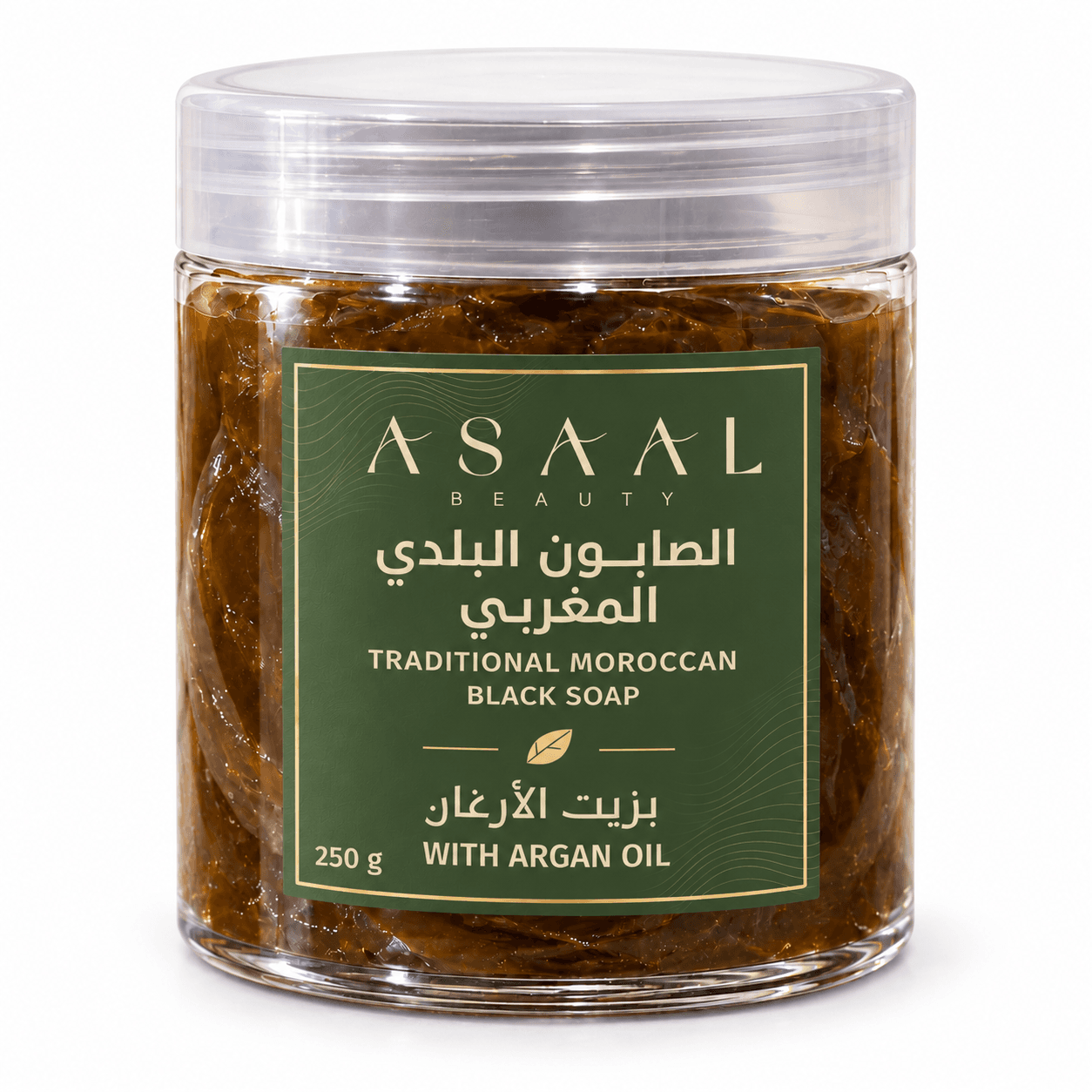
Asaal Beauty Moroccan Black Soap with Argan Oil features a rich texture designed for a hammam-inspired body-care routine.
4. Does real Moroccan black soap have to be black?
Not necessarily.
Despite its English name, traditional Moroccan black soap may appear in several dark shades, including:
- Deep brown.
- Dark olive green.
- Brown-black.
Its appearance depends on the ingredients and the formulation.
A deep-black color does not automatically prove authenticity, and an olive-brown shade does not make a product inferior.
Color is useful for understanding a product's appearance, but it is not a definitive test of quality or ingredient authenticity.
5. Evaluate the scent without relying on it alone
Traditional Beldi formulations may have a scent associated with their botanical ingredients.
Other versions include eucalyptus oil or additional fragrant components.
As a result, different Moroccan black soaps can smell quite different.
A naturally scented formula, an aromatic eucalyptus version, and an argan oil-enriched product may each offer a distinctive bathing experience.
Choose a scent and ingredient profile that suits your preferences and skin tolerance.
Remember that fragrance alone cannot verify authenticity.
6. Check origin and packaging information
Country of origin is an important consideration for anyone specifically seeking Moroccan-origin Beldi soap.
Moroccan black soap is deeply connected to the country's traditional hammam culture.
Look for clear product information, including:
- Country of origin.
- Full ingredient list.
- Net weight.
- Batch or production details.
- Shelf-life information.
- Directions and storage instructions.
If purchasing a product specifically marketed as made in Morocco, check the declared country of origin rather than assuming it from the brand name.
Complete labeling and clear product information make comparing different soaps easier.
7. Choose value and brand reliability over appearance alone
Moroccan black soap is available at a wide range of price points.
Prices can vary according to ingredients, packaging, product weight, distribution, and brand positioning.
An expensive jar is not automatically better, and an affordable product is not automatically low quality.
Compare the ingredient profile, net weight, intended use, and clarity of the product description.
A trustworthy choice is one that fits your needs and provides clear information about what you are buying.
Moroccan black soap types: Which formula should you choose?
Not every Moroccan black soap has the same ingredients.
Olive-based Moroccan black soap
This variety is closely connected to traditional Moroccan Beldi soapmaking.
It is a natural starting point for consumers who enjoy a classic hammam-inspired cleansing ritual.
Moroccan black soap with argan oil
This formulation incorporates argan oil into the Moroccan black soap experience.
Argan oil is a Moroccan botanical oil naturally containing fatty acids and vitamin E compounds.
For those who enjoy argan oil in beauty products, an argan-enriched Beldi soap offers an appealing variation on the traditional formula.
Asaal Beauty Moroccan Black Soap with Argan Oil is one example of this combination.
Moroccan black soap with eucalyptus
Eucalyptus-containing formulas are often chosen for their refreshing herbal aroma.
They can appeal to those who prefer a more aromatic hammam experience.
Moroccan black soap with other botanical oils
Some formulas contain additional oils or fragrant ingredients, including lemon-related or other aromatic components.
The best option depends on your preferences, the actual ingredients, and how your skin responds.
What is the best Moroccan black soap for the body?
The best choice depends on your body-care goals.
For a traditional hammam experience: Look for a rich Beldi-style paste with clear ingredient information.
For an argan oil-enriched formula: Choose Moroccan black soap containing argan oil.
For a refreshing aromatic experience: Consider a formula with botanical fragrance ingredients that suit you.
For dry skin: Make moisturizing part of your bathing routine and avoid aggressive exfoliation.
For sensitive skin: Review the ingredients carefully and introduce exfoliation gradually, if appropriate.
If you are looking for traditional Moroccan-inspired cleansing with argan oil, Asaal Beauty offers a product designed for that combination.
Why choose Asaal Beauty Moroccan Black Soap with Argan Oil?
At Asaal Beauty, our products bring Moroccan-inspired body-care rituals into everyday routines.
Our Moroccan Black Soap with Argan Oil is available in a 250 g jar, with a rich texture and a formula containing argan oil.
Its key features include:
- Exfoliating body care: Works as part of a Moroccan hammam routine to remove dead skin cells, particularly when combined with a Kessa glove.
- Body cleansing: Helps wash away surface impurities and oils.
- Softer-feeling skin: Leaves the body feeling refreshed and smooth after suitable cleansing and exfoliation.
- Argan oil-enriched formula: Combines Beldi-style cleansing with one of Morocco's best-known botanical oils.
- Versatile use: Can be used for body cleansing on its own or alongside a Moroccan Kessa glove.
- Convenient size: Comes in a 250 g jar for at-home body care.
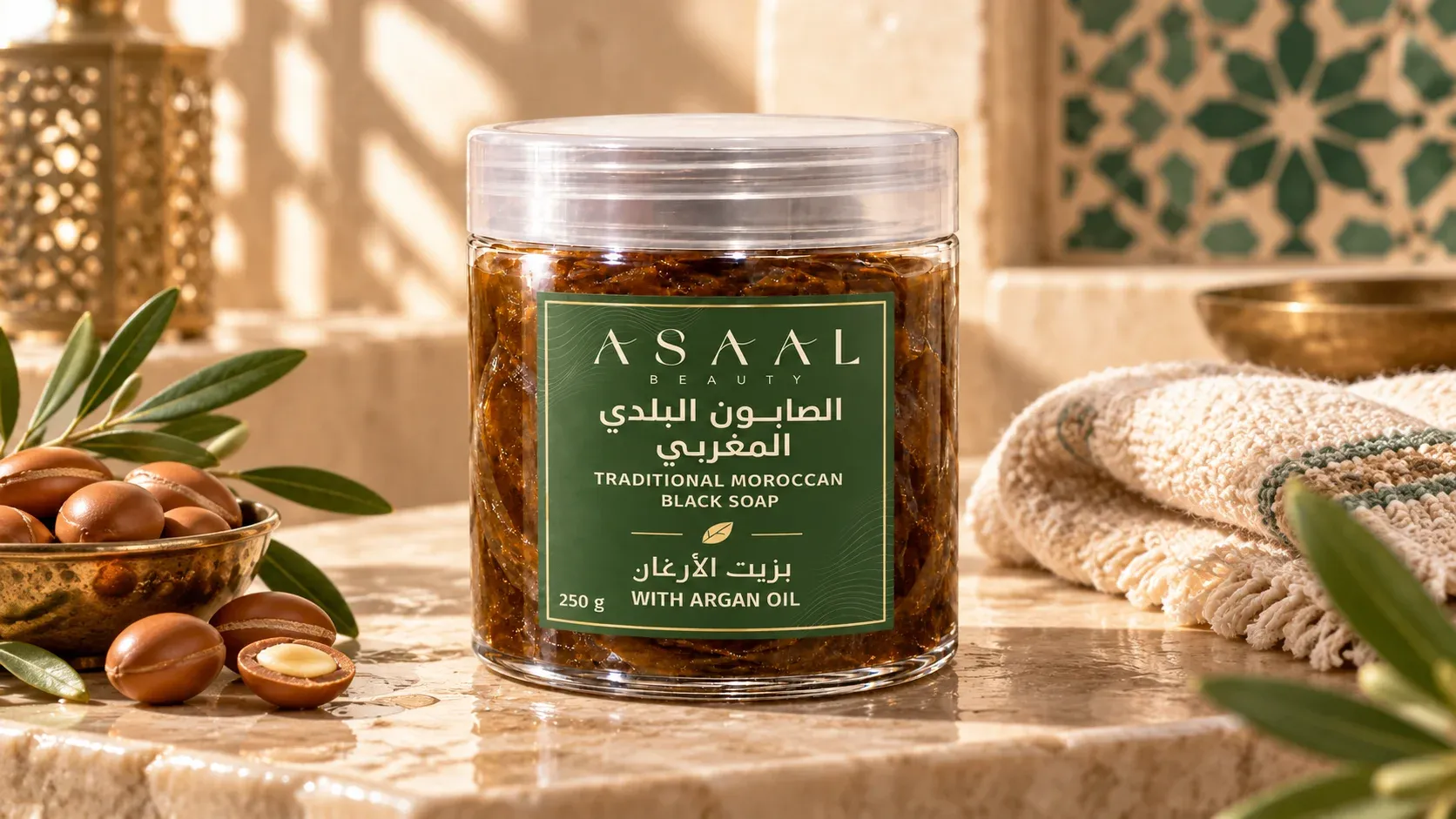
The transparent jar allows you to see the soap's appearance and texture, while the signature green Asaal Beauty label reflects the brand's distinctive identity.
Explore Asaal Beauty Moroccan Black Soap with Argan Oil — 250 g on our official store.
How to compare Moroccan black soap sizes
Net weight matters when comparing products.
A 500 g jar contains twice the quantity of a 250 g jar, but the price difference may not follow the same proportion.
Comparing the cost per 100 g can help you evaluate value across different products.
However, a larger jar is not always necessary.
For someone beginning a hammam-inspired routine or looking for a practical body-care product, a 250 g jar is a convenient choice.
How long it lasts depends on how much soap is used during each session and the frequency of use.
How to choose Moroccan black soap for your skin type
Normal skin
A body-formulated Moroccan black soap can be incorporated into a regular cleansing routine, with Kessa-glove exfoliation added when suitable.
Dry skin
Follow cleansing with an appropriate moisturizer and avoid excessive friction.
You can also incorporate Asaal Beauty Organic Moroccan Argan Oil into your after-shower body-care routine.
Oily skin
Moroccan black soap can be used to remove dirt and excess surface oils.
There is no need to scrub aggressively to achieve a clean, refreshed feel.
Sensitive skin
Review the ingredients and test a new product carefully before widespread use.
If your skin is easily irritated, avoid rough mechanical exfoliation and choose a routine suited to its tolerance.
Does authentic Moroccan black soap remove dead skin and brighten the body?
Moroccan black soap is widely used in a hammam routine that removes accumulated surface dead skin cells, particularly when paired with a Kessa glove.
Removing surface buildup supports softer-feeling skin and a fresher, more radiant appearance.
This is one reason Moroccan black soap is popular in body-brightening and exfoliation routines.
For an in-depth guide, explore Moroccan Black Soap Benefits for Skin: Exfoliation, Dead Skin Removal, and Softer Skin.
How do you use Moroccan black soap?
Once you have chosen your soap, a simple body-care routine is all you need:
- Wet the body with comfortably warm water.
- Apply the soap to damp skin and massage gently.
- Rinse thoroughly.
- Use a clean, damp Kessa glove with gentle strokes to exfoliate if appropriate for your skin.
- Rinse again, pat the body dry, and finish with a suitable moisturizer.
For the complete routine, read How to Use Moroccan Black Soap with a Kessa Glove at Home.
Common mistakes when buying Moroccan black soap
Judging the product by color alone: Dark color does not automatically establish authenticity.
Assuming every black soap is Moroccan Beldi soap: Different types of black soap can have different origins and formulas.
Treating scent as an authenticity test: Aroma varies with ingredients and fragrance.
Ignoring the ingredient list: Understanding the formulation matters more than the front-label description alone.
Comparing prices without comparing weights: Product size affects value.
Choosing solely by packaging design: A beautiful jar cannot replace clear product information.
Overlooking skin type: The right application method is just as important as choosing the soap.
Frequently asked questions about authentic Moroccan black soap
How can I tell if Moroccan black soap is real?
Check that the product is Beldi-style Moroccan black soap, review its ingredient profile and paste-like texture, and look for clear country-of-origin and product information.
What color is authentic Moroccan black soap?
Traditional formulations commonly appear in dark brown, olive-green, or brown-black shades.
Is real Moroccan black soap soft or solid?
Traditional Savon Beldi is generally soft and paste-like, unlike many ordinary solid soap bars.
Is Moroccan black soap made from olives?
Traditional Beldi soap is closely associated with olive-derived ingredients, although contemporary formulas may incorporate additional botanical oils.
Which Moroccan black soap is best for body care?
Choose a clearly described formulation that suits your skin and preferences. Argan oil-enriched Moroccan black soap is one option for those who prefer this botanical ingredient.
Is Moroccan black soap with argan oil a good choice?
Yes, it combines Moroccan hammam-style cleansing and exfoliation with a formula containing argan oil, as offered in Asaal Beauty's 250 g product.
Is every black soap Moroccan?
No. African black soap and other dark soaps may have different origins, compositions, and traditional uses.
Does expensive Moroccan black soap mean better quality?
Not necessarily. Compare formulation, ingredients, product weight, and brand transparency rather than price alone.
Do you need a Kessa glove?
No. Moroccan black soap can be used for body cleansing on its own. A Kessa glove is commonly added for traditional mechanical exfoliation.
Can both men and women use Moroccan black soap?
Yes. Its suitability depends on the individual's skin and preferences rather than gender.
Where can I buy Moroccan black soap with argan oil?
You can order Asaal Beauty Moroccan Black Soap with Argan Oil — 250 g directly through the official Asaal Beauty store.
Final thoughts: Choose Moroccan black soap with confidence
The best way to evaluate Moroccan black soap is to look beyond its dark color or scent.
Understand the ingredients, texture, origin, labeling, product weight, and intended use. These details help you find a product that suits your body-care routine.
For those seeking an argan oil-enriched hammam experience, Asaal Beauty Moroccan Black Soap with Argan Oil, 250 g brings cleansing, exfoliation, and softer-feeling skin into one Moroccan-inspired ritual.
Asaal Beauty — Moroccan-inspired care, thoughtfully chosen for your everyday routine.
Sources and further reading
Curated Picks for Your Ritual
Handpicked recommendations to complete what you started in this article.